

It's fundamentally impossible for a government to control the economy. It ALWAYS leads to economic failure.
And yet... China is the 2nd most powerful economy and it's not quite on the verge of failure (yet?). Even if China now has a "free market" and too much economic activity to be 100% controlled by the state, the government still have a huge hand over their economy and large business plans.
And we're clearly witnessing that having no control over the economy also leads to economic (and politic, social & ecologic) failure, on a worldwide scale. I'm not saying China is the perfect exemple and everyone should do the same, far from it.
But we need something else, new models, new ways of managing ourselves and the economy. What we DO NOT need, is 2 blond dipshits making empty promesses for stupid people.
Not true, there is nothing to gain from reducing national debt because it means spending money on essentially nothing. What would you rather, spend 10t on reducing debt, or spend 10t on infrastructure, industry, spending, etc.
I don't think that invalids my point that they have nothing to gain from paying the debt back and yet it's one of their main campaign theme ; no one has anything to gain from it but the private entities who lend the money out of thin air in the first place (and the politics who take advantage of their "intermediary position" inbetween the people/consumers/human ressources and the banks).
The only benefit of paying off debt is less interest, and because of USA's credit rating of AAA they pay such a small amount of interest (just over 200b) that it absolutely does not matter. Do you think giving Americans 10t to spend will bring more than 200b in returns? Of course it will...
EDIT : I'm not sure what you mean by "10t" and "200b", these Ts and Bs, english not being my main language. I'd like the entire words so I can have a literal translation ^^
from a "capitalo-capitalist" point of view with quite the lack of hindsight, that's probably the stand to adopt ; You do realize the credit rating is bullshit though ? submit the people and the economy to please some private banks giving some non-sense rating for smaller interests on a debt that's mathematically impossible to pay back. Let us remind the debt of the US is more than 100% of its GDP. It's a nice carrot-stick control situation.
And you think that putting money in to the pockets of citizens is:
A. Contrary to making USA rich?
B. Contrary to getting rid of the bubble?
C. Contrary to reducing debt?
It's A+B+C cap'tain. I think debt creation doesn't work the way you think it works.
Money is created from nothing and lended with interests by private parties. Which means the money you'll put into citizens pocket is money the country owes, plus interests. All the money in circulation literally fuels the economy/activity of the country, but it doesn't multiply itself magically, only private banks can do that for some reason. The only way to reduce it would be if these private parties would re-inject their money in the economy out of good will, which they won't.
There's no reducing the debt, and there's no continuing on the same road expecting it will somehow get better. The only reasonnable thing people can do is refusing to pay the debt and refusing to hand political legitimacy to a couple of goatsucking dipshits... or accepting to have their ass owned by private entities on the long run ; no more sovereign state, no more constitution, no more democratic progress, no more justice... a perfect dystopia ;o
Last edited by deprav; Sep 3, 2016 at 03:16 PM.


Originally Posted by wibblefox

"I don't think there is a fast way to get rid of debt, by necessity you have to play the long game. It's not really realistic to not have any government spending for 5 years just to wipe out debt is it? Again, you have to look a little further in to the future."
Can you answer the questions though? Youve quoted a piece of text which is only slightly relevant to one of the two questions.
Or alternatively do you think he is being deliberately misleading by meaning he will try and decrease the debt in the far future when thats not what the wording is designed to sound like?
Don't dm me pictures of bowls that you find attractive.
Originally Posted by wibblefox
If you want to know what Trump thinks ask Trump...
I think he clearly says "Weve [sic] got to get rid of the $19 trillion in debt" so I think that clearly means he wants to handle the debt..............
The question was: do you think he is being deliberately misleading by meaning he will try and decrease the debt in the far future when thats not what the wording is designed to sound like?
The answer you gave was: He wants to handle the debt.
This does not answer the question.
In addition it is not actually very realistic for me to go and personally ask Trump.
In your answer you said:
"Weve [sic] got to get rid of the $19 trillion in debt" so I think that clearly means he wants to handle the debt..............
Does this mean he intends to get rid of the debt in his term? Or handle the debt by letting it grow?
The first term is unrealistic, if it is the second case he is clearly being deliberately misleading the electorate by saying "Weve got to get rid of the $19 trillion in debt".
Don't dm me pictures of bowls that you find attractive.

Originally Posted by wibblefox
Well not his words because I can't even find the word "reduce" in the entire interview.
You want me to read a 20,000 word interview? Sorry, not going to happen.
How about you give me a direct quote.
Smallbowl did. If I read through your arguments correctly, you say that because we can't remove the debt quickly, we have to play the long game.
It's true that we can't remove the debt quickly. Trump did in fact catch a lot of flak for saying that he'd get rid of the debt in 8 years (in that interview I linked). That said, there's really ultimately only 1 way to run that down... spur economic growth enough while keeping debt growth low so that debt to gdp ratio decreases, or running surpluses to actively pay down the debt. Obviously, to do either you can't be substantially increasing debt growth so that gdp growth is unable to outpace it.
A debt to gdp ratio development stat is already useless if expected gdp growth isn't accounted for along with debt, so you expect the tax cuts to spur totally unexpected growth, or....?
Originally Posted by wibblefox
Trying to do a smallbowl here mate?
daaaaaamn this image is huuuuuuuuge
Come on step it up.
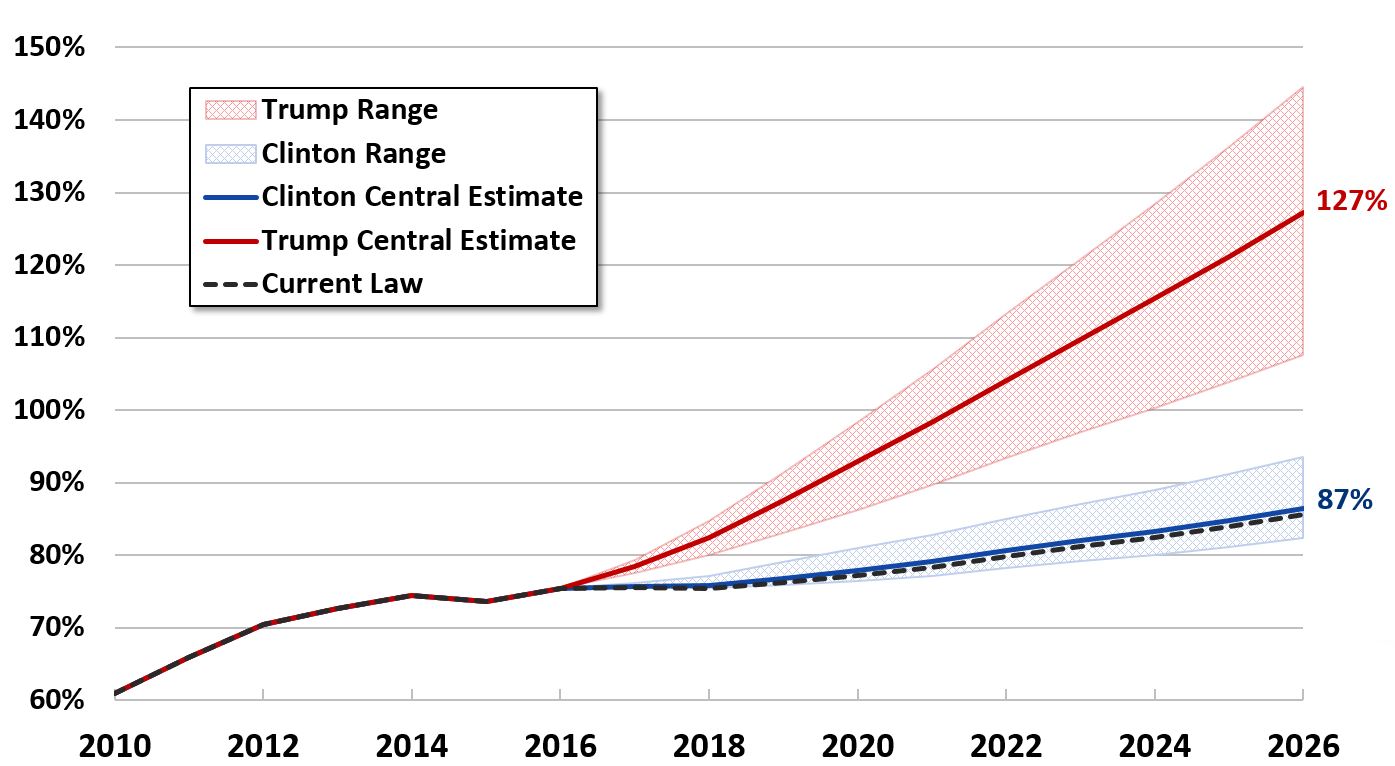
the number i was referring to, since it was conveniently quoted in the article i linked, was total debt. NOT debt held by the public. stop trying to play a "gotcha" game by using different numbers.
then again i'm not sure why i should expect anything different
Originally Posted by wibblefox
1.) I can't speak for his values
2.) That is an unfounded assertion especially when you have back peddled from "it's bad because it's bad" to "it's bad because it contradicts his values"
Increasing spending is a very common way to defend against recession. Pretty much every country does this. If he believes there to be a bubble, then it follows that he wants to increase spending to combat it. This is sound economics. A nearly $10t cash injection into the economy at all levels is great.
Increasing spending is an extremely common way in modern economics to stimulate a country out of a recession. Most countries do do this. However, if he believes there to be a currently expanding bubble, then it should follow that he needs to deflate it before it pops. Pumping cash into the bubble so it expands even more is not sound economics.
Imagine if the fed did rounds of qe in 2006 lmfao
Originally Posted by wibblefox
The government cannot and does not control the economy.
Every economist agrees that debt is good.
Your assertion that it is "irresponsible" is unfounded.
Your assertion that deficit is "just right" because Obama put it there with his horrendous management skills is also unfounded.
It's fundamentally impossible for a government to control the economy. It ALWAYS leads to economic failure.
What in the world is your standard for government control over the economy? Price controls, government monopoly on production...?
The fed pegs interest rates successfully, which does exactly what its supposed to do to the economy. a clear example of a government entity with its hand on the economy, controlling it in various ways.
fiscal policy has an undisputed effect on the economy. you just said earlier that governments can combat recessions through increased spending. how is that not controlling the economy?
debt is not inherently good. having no debt is bad, which iirc i read that you switched your stance to a few posts later
not really. bits and pieces are laid out through this post why that is
also, since you're feeling really scapegoaty, i should remind you that congress is the entity that passes the budget, not the president
Originally Posted by wibblefox
Not true, there is nothing to gain from reducing national debt because it means spending money on essentially nothing. What would you rather, spend 10t on reducing debt, or spend 10t on infrastructure, industry, spending, etc.
The only benefit of paying off debt is less interest, and because of USA's credit rating of AAA they pay such a small amount of interest (just over 200b) that it absolutely does not matter. Do you think giving Americans 10t to spend will bring more than 200b in returns? Of course it will...
you mean, their credit rating of AAA and the fact that interest rates are the lowest they've ever been.
https://www.cbo.gov/publication/45684
this is from 2014, but still relevant. obviously that doesn't account for expected debt increases under a trump presidency, but based on their math it follows that we'd start paying something short of 1t in interest by 2026ish
reducing national debt to reduce interest payments required each year frees future tax revenues to be put to more useful things. where'd your long game thought go that you had a few posts ago?
if we did social spending, jobs programs, or programs that specifically target the consumer population/working class that has stagnated the past 20 years and especially stagnated since the crash in '08 in order to stimulate aggregate demand, and used deficits to finance that then great. tax cuts that by and large affect the class least likely to spend (upper class) and the class least damaged in this economy (upper class) aren't going to promote any real or substantial growth, and taking on substantial debt in order to finance spending in lieu of those lost revenues is madness
Originally Posted by wibblefox
And you think that putting money in to the pockets of citizens is:
A. Contrary to making USA rich?
B. Contrary to getting rid of the bubble?
C. Contrary to reducing debt?
I don't think there is a fast way to get rid of debt, by necessity you have to play the long game. It's not really realistic to not have any government spending for 5 years just to wipe out debt is it? Again, you have to look a little further in to the future.
A. if more and more public spending has to be allocated to interest payments because of wayward debt due to lost tax revenues where debt outpaces the expected marginal growth caused by lowering taxes, yes.
B. Unless the bubble has already popped and we're feeling the pain of a recession, then it is perfectly contrary.
C. if substantial debt must be taken in order to compensate for lost taxation revenues and the specific cuts in taxation have the expected effect on the economy (low or unsubstantial growth, especially in the short term), then yes.
Originally Posted by wibblefox
Cool, they agree that reducing tax will raise GDP. That is exactly what the tax cuts are expected to do, as I have stated many times before.
Increase GDP, debt as percentage of GDP decreases. Wow did I just do magic or did I just reduce proportional debt just be increasing GDP?
Of course they do, it'd be silly to expect tax cuts to lower gdp. Whether they increase gdp substantially is an entirely different issue. aaaaand the heart of your magic trick.
if you have to go into substantial debt to perform tax cuts, then debt to gdp ratio either doesn't go anywhere, or falls. half rate magician smh
Originally Posted by wibblefox
As we have said many times, debt is not an inherently bad thing. Wasting money to pay off debt is not an inherently good thing. Strengthening the economy will lead to prosperity in the private and public sectors, without a doubt.
neither is debt an inherently good thing, as you've suggested. wasting money to pay off debt can absolutely be counterproductive, but wastefully spending money can absolutely be counter productive as well.