


Toribash
  1. The room for removing the skins should be 14 to 16º C (57.2 to 60.8º F) to ensure the skins are maintained within a cold chain.

  2. Once bled and defeathered, first remove the shin skins from the lower legs. The scales of the shin should be in the center otherwise they are of no value.

  3. Invert the bird so that it is hanging by its wings. Follow the cutting lines as per the diagram. Deskinning with the use of a cradel is not recommended.

  4. For skin removal, use only one operator. Using more than one operator can cause an operator to damage the skin with cuts as the other operator moves the bird.

  5. The neck of the bird is typically trimmed 20 cm (7 3/4 inches) above the featherline, and the leg some 10 to 15 cm (4 to 6 inches) above the "knee".

  6. Hose down the skin with water to remove blood and cool the skin.

  7. Use a blunt tool to remove access fat. Do not use a knife as this can accidentally cause cuts.

  8. Place the skin flesh side up flat on a pallet. Ensure that the pallet has some form of protection eg. a sheet of cardboard to avoid damage from the nails and the slats in the pallet. Similarly avoid contact with any metals such as the salt shovel against the skins.

  9. Use fine grain salt to heavily salt down the skin. Avoid coarse salt. The salt should cover all parts of the skin. Skins are living organisms. Salt dehydrates the skin, thereby restricting any bacterial growth. If insufficent salt is used, then this dehydration process is incomplete and bacterial growth will eat into the skin causing damage. Use plenty of salt. Typically 5 kg. of salt per skin.

  10. It is best if the pallet is on a slope to encourage drainage. Similarly it is best if the skin is not folded at this stage to assist in the draining process.
We have successfully produced ostrich skins without the use of a biocides before salting down. Since there are so many options on biocides, we prefer at this time not to comment on this aspect until we have more concrete data. However, we would like to say that if an animal slaughter plant is using them, then treat ostrich skins no different. In our opinion, what works for other skins, will most likely work for ostriches. Skins are typically placed in a biocide fo 30 minutes, piled to drain excess solution and then salted down.

Retired
Every once in a while, we highlight a questionable Faux-To on WonderHowTo. For example, tested false by Mythbusters and others, the tennis ball car break-in method appears to be completely debunk (even though Russell Crow pulls it off in his latest film, "The Next Three Days").
However, in the case of cannibalism, there's no debate about it. No question: this is a Faux-To.
Please, DO NOT attempt to eat a human, not matter how clear these instructions are. But, in the event of the apocalypse, now you know: eating the brain will make you go crazy, and the buttocks make a good Sunday roast.
Click through to io9 for enlarged viewing.
HowTo: Butcher a Human
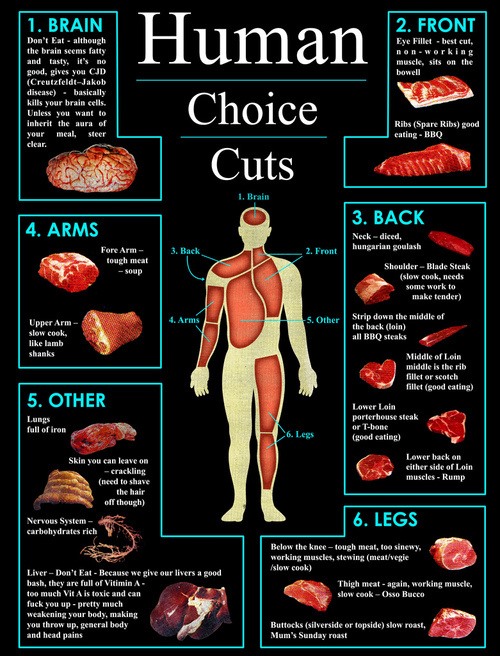

Retired
Genocide is a human phenomenon that can be analysed and understood, and consequently, may be prevented. According to academic and activist Gregory H. Stanton, genocide is a process that develops in ten stages, described here. The stages do not necessarily follow a linear progression and may coexist. Prevention measures may be implemented at any stage.
1. Classification

Groups in a position of power will categorize people according to ethnicity, race, religion or nationality employing an us versus them mentality.
Prevention: Create universalistic institutions that foster social cohesion.
2. Symbolisation

People are identified as Jews, Roma or Tutsis, etc., and made to stand out from others with certain colours or symbolic articles of clothing.
Prevention: Ban the symbols and hate speech and all clothing meant to discriminate against groups.
3. Discrimination

A dominant group uses laws, customs, and political power to deny the rights of other groups. The powerless group may not be granted full civil rights or even citizenship.
Prevention: Ensure full political empowerment and citizenship rights for all groups in a society. Discrimination on the basis of nationality, ethnicity, race or religion should be outlawed.
4. Dehumanisation

The diminished value of the discriminated group is communicated through propaganda. Parallels are drawn with animals, insects or diseases.
Prevention: Promptly denounce and punish perpetrators and make hate crimes and speech culturally unacceptable. Sanction all incitements to commit genocide.
5. Organisation

A state, its army or militia design genocidal killing plans.
Prevention: Outlaw membership in these militias and sanction their leaders. Impose arms embargoes on the countries involved and create commissions of inquiry.
6. Polarisation

Propaganda is employed to amplify the differences between groups. Interactions between groups are prohibited, and the moderate members of the group in power are killed.
Prevention: Protect these moderate members and human rights groups. Seize the assets of the oppressors and refuse their access to international travel.
7. Preparation

The victims are identified, separated and forced to wear symbols. Deportations, isolation and forcible starvation. Death lists are drawn up.
Prevention: Humanitarian aid, armed international interventions or major support for the victims to ensure their ability to defend themselves.
8. Persecution

Victims are identified and isolated based on their ethnic or religious identity. Death lists are drawn up. In state sponsored genocides, members of victim groups may be forced to wear identifying symbols. Their property is often expropriated.
Prevention: Regional organisations and the international community must mobilise themselves to assist or help the victims.
9. Extermination

The massacres begin. The perpetrators see their actions as “extermination” since they do not consider their victims to be entirely human.
Prevention: Only large-scale armed interventions can stop genocide. The international community must support the operations by providing air transport, equipment and financial support.
10. Denial

The perpetrators of the genocide deny having committed their crimes. Victims are often blamed. Evidence is hidden and witnesses are intimidated.
Prevention: An international tribunal or national court must prosecute the criminals. Public education.

Retired
In principle it's very easy - get a critical mass of radioactive material, sit back and watch the runaway nuclear reaction go. But luckily for us it's the first part - getting the radioactive material - that is the biggest stumbling block.
Earlier this week, Iran joined the growing list of countries suspected of developing nuclear weapons. On Monday the European Union said Iran's nuclear reactors could make the radioactive raw materials needed for a nuclear bomb and demanded weapons inspectors be allowed in.

"You cannot make a nuclear bomb without fissile material," says Andrew Furlong, of the Institute of Chemical Engineers. And for an average thermonuclear device, the necessary material is plutonium or enriched uranium.
Uranium, a naturally-occurring heavy metal, comes as uranium 238 or 235. Both are radioactive and will decay into other elements, given time, but only the latter can be forcibly split when neutrons are fired at it. This is the basis of a nuclear bomb.
When an atom breaks apart, it gives out energy and more neutrons, which can then split other atoms. Get enough atoms splitting and you have the chain reaction needed for a bomb blast.
But natural uranium overwhelmingly consists of the 238 isotope, which bounces back any neutrons striking it - useless then for a bomb. To make a bomb, natural uranium needs to be treated to concentrate the 235 isotope within it.

And this is where the problems re ally begin. For every 25,000 tonnes of uranium ore, only 50 tonnes of metal are produced. Less than 1% of that is uranium 235. No standard extraction method will separate the two isotopes because they are chemically identical.
Instead, the uranium is reacted with fluorine, heated until it becomes a gas and then decanted through several thousand fine porous barriers. This partially separates the uranium into two types. One is heavily uranium 235, and called "enriched" while the rest is the controversial "depleted" uranium used to make conventional weapons.
To make a nuclear reactor, the uranium needs to be enriched so that 20% of it is uranium 235. For nuclear bombs, that figure needs to be nearer 80 or 90%. Get around 50kg of this enriched uranium - the critical mass - and you have a bomb. Any less and the chain reaction would not cause an explosion.

You could use plutonium instead. According to Keith Barnham, a physicist at Imperial College, this is the preferred material because it makes much lighter weapons that can be mounted on to missiles.
Plutonium is produced as a by-product in nuclear reactors and only around 10kg is needed for a bomb. An average power plant needs about a year to produce enough and expensive reprocessing facilities are required to extract the plutonium from the fuel.
With the basic material, life gets easier. The bomb will explode once the critical mass of uranium or plutonium is brought together. So, to begin with, and to make sure that it doesn't explode in the hands of its owners, the bomb needs to keep the metal separated into two or more parts. When the weapon is in place and ready to go off, these sub-critical masses need only be thrown together - and this can be done with conventional explosives.

The chain reaction, explosion and familiar mushroom cloud then take care of themselves.
part of the uri-nation rateyourmusic
frog up his ass or something
Originally Posted by piss View Post
hey life

Hey piss, did you know that orange piss is really bad for your health
Former Admin, Smod, Market Squad, Clan Squad and Toriagent. If you got any questions please don't contact me, thank you!